Hmm, I think at minimum calculus will need to be involved here. Because we can’t just assume that the heat is spread evenly in the copper - it’ll likely be hotter at the bottom, leading to thermal throttling earlier than expected. On the other hand, there’s going to be heat dissipation into the air, which will help cool the block somewhat
Edit: made a program to model heat transfer and heat loss. It seems to only affect final time by a handful of seconds. So actual time in real life is probably somewhere in the ballpark of 10 minutes
I left another comment going into more detail about the model specifications, if you’d like to read into it. But briefly: I took the copper heat conductivity coefficient and the air heat transfer coefficient. I sliced the copper block into thin slices and modeled heat transfer between each slice, as well as heat transfer between each slice and the surrounding air.
It seems that both heat transfer and heat loss do actually matter quite significantly, but they just cancel each other out almost entirely.
If we assume instantaneous heat transfer, thermal throttling time goes up from 592 seconds to 703 seconds (about 2 minute difference).
If we assume no heat loss to the air, thermal throttling time goes down from 592 seconds to 500 seconds (about 1.5 minute difference).
Copper conductivity is fast, sure, but it’s not fast enough to have equal temperatures at the top and bottom for such a big chunk of copper. That does affect the time to thermal throttle pretty significantly, actually. If we assume completely homogeneous temperatures across the block (ie, instantaneous heat transfer), according to my model, it’ll take 703 seconds to thermal throttle. With heat transfer, the time drops to 592 seconds - a difference of about 2 minutes


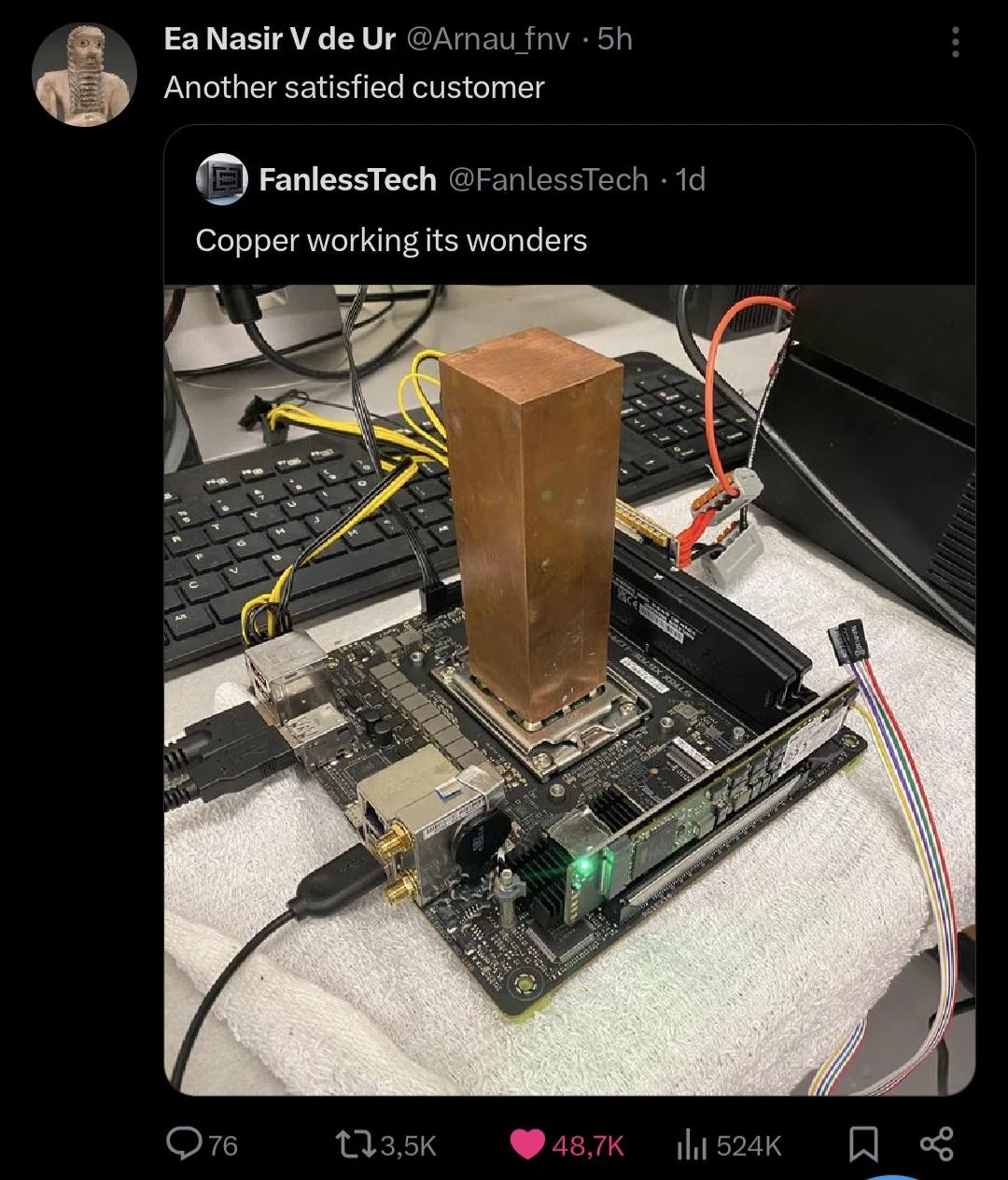
Hmm, I think at minimum calculus will need to be involved here. Because we can’t just assume that the heat is spread evenly in the copper - it’ll likely be hotter at the bottom, leading to thermal throttling earlier than expected. On the other hand, there’s going to be heat dissipation into the air, which will help cool the block somewhat
Edit: made a program to model heat transfer and heat loss. It seems to only affect final time by a handful of seconds. So actual time in real life is probably somewhere in the ballpark of 10 minutes
Heat transfer will not limit much, but heat loss should add a significant amount of time. How did you model that?
I left another comment going into more detail about the model specifications, if you’d like to read into it. But briefly: I took the copper heat conductivity coefficient and the air heat transfer coefficient. I sliced the copper block into thin slices and modeled heat transfer between each slice, as well as heat transfer between each slice and the surrounding air.
It seems that both heat transfer and heat loss do actually matter quite significantly, but they just cancel each other out almost entirely.
If we assume instantaneous heat transfer, thermal throttling time goes up from 592 seconds to 703 seconds (about 2 minute difference).
If we assume no heat loss to the air, thermal throttling time goes down from 592 seconds to 500 seconds (about 1.5 minute difference).
The conduction in copper is fast enough that there’s not much of a difference between the top and bottom.
Copper conductivity is fast, sure, but it’s not fast enough to have equal temperatures at the top and bottom for such a big chunk of copper. That does affect the time to thermal throttle pretty significantly, actually. If we assume completely homogeneous temperatures across the block (ie, instantaneous heat transfer), according to my model, it’ll take 703 seconds to thermal throttle. With heat transfer, the time drops to 592 seconds - a difference of about 2 minutes
deleted by creator