
You must log in or # to comment.
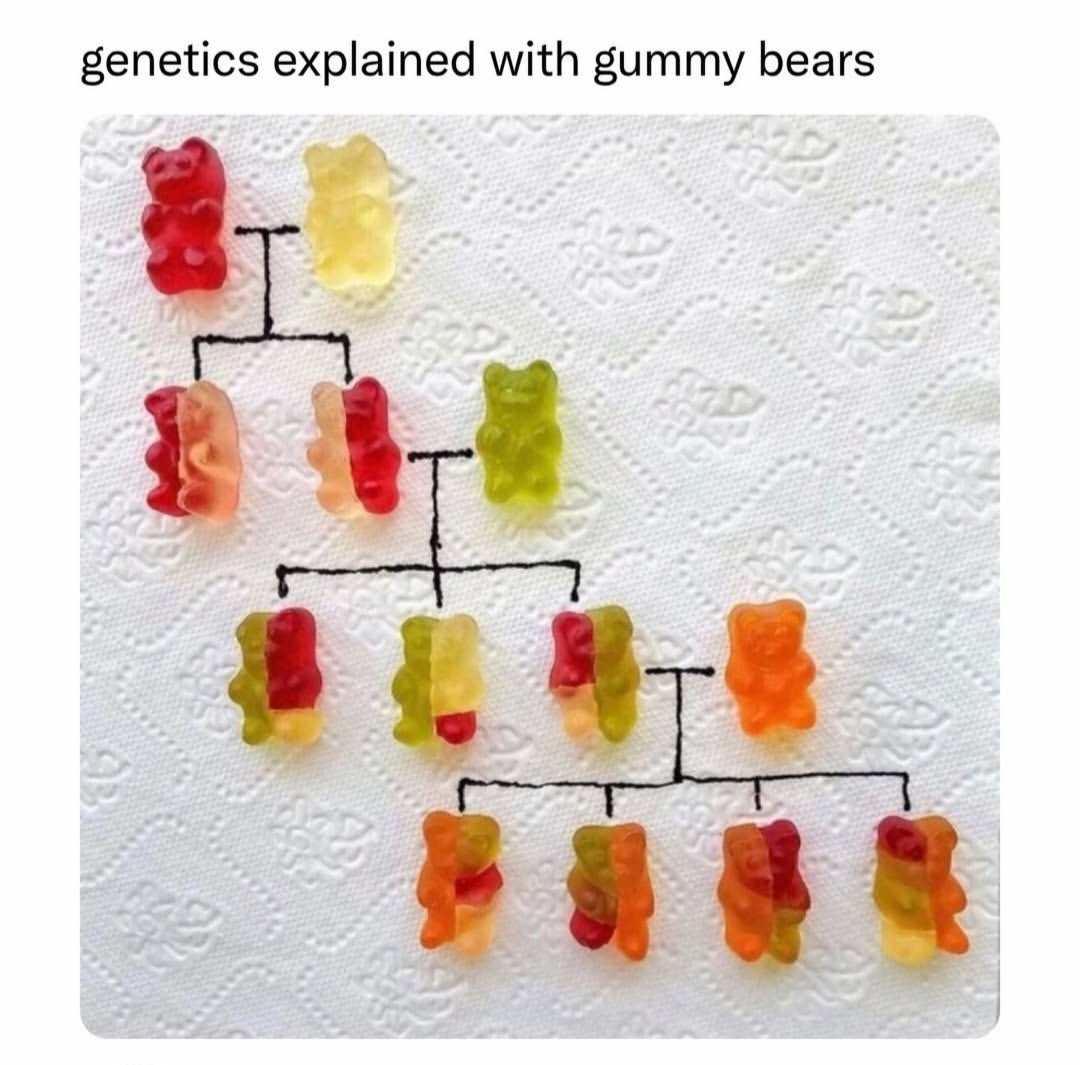
It gets the point across well enough, but there are some issues if you get deeper with it.
First, the colors would swap back and forth much more often, blurring together into a single color at this scale, much like how small alternating black and white dots can be used to make us see a gray color. We can get around that issue by assuming that they’re just organized into groups by parent of origin, rather than being actual representation of the exact DNA order, though.
Next, the proportion of colors is off, especially in the last generation. You’ll get different amounts of DNA from one progenitor to another, but it’s always pretty close to an equal split halved by generation, so the first 2 bears in the 3rd generation would be much closer to the proportions seen in the 3rd than they really are, and the bears in the 4th generation would all be 1/2 orange, 1/4 green, and 1/8 each of red and yellow.
Finally, the first 2 bears of the 3rd generation seem to have been given the “missing” DNA from their red/yellow parent, with one having mostly red and a little yellow, and the other having mostly yellow with a little red. While this is technically possible, it’s no more likely than any other of the near-infinite variations 2 separate siblings could have instead. Someone using this as a way to understand inheritance may get the incorrect notion that one sibling inherits what DNA the previous sibling didn’t, when it’s instead completely random each time.
Ultimately, this is a good way to introduce the concept of genetics and inheritance to someone who may be having trouble picturing it in their mind, but more information would need to be provided for them to truly understand it.
Royal houses: if we avoid the green and the orange eventually we’ll get the first two back.
Not geneticist, but this appears to be a metaphor for “punnet squares”. These are the box diagrams that purport to show the percentages of different genetic traits based on mixes of dominant and recessive genes.
Again, not a scientist, but this is the stuff we learned in the 80s in science class, before the human genome project was even undertaken. The reality now, I’m fairly certain, is that even something as simple as eye color actually has a lot more complexity behind it than these simple boxes. And the expression of genes and the proteins they code for depend on the interaction of a lot of processes, many of which we don’t have a complete picture of yet.
these genetics are delicious.
I’ll need a larger sample set… uh… for science.
This does not explain anything.
If this is a whole genome thing, and not just looking at a small group of alleles, it is incredibly unlikely that two of the great-grandchildren would have no contribution from the white great-grandparent. It’s so unlikely that I wouldn’t be surprised to learn that it’s unlikely to have ever happened throughout all of human history.