I’m a big fan of protecting our environment but this fails because it’s a straw man.
Everyone knows that the things we get far more than “nothing” from our rampant pollution. We get fast transportation, abundant food, and vast material wealth.
If we were really giving up “nothing” it would be an easy choice. Very few people would be willing to pollute just for the sake of polluting. Even if we only got a little bit of benefit from pollution there would still be incentive to pollute.
Instead we get a ton of benefit out of pollution and we’d have to give them up if we wanted to stop polluting.
The more honest take is that polluting activities have a tradeoff. If we keep polluting at our current rate, we’ll eventually push the ecosystem to a state where it can’t sustain us. We need to be willing to make some hard sacrifices to prevent that and we need to identify those sacrifices, rather than pretending they don’t exist.
Quite a lotta opinions people have on this comment chain, lemme throw mine in too while the gettin’ is good! Also Tl;Dr: We can fix it, but think of the shareholders!
I’ve come to interpret a lot of these modern problems and solutions as questions of capital. To sound like a broken record, having as highly capitalist of an economic system as we do creates a lot of these incentives, so much so that I feel the question itself isn’t necessarily a question of climate policy, but rather a question of our relationship between company and government. Partially because we have a cyclical system of: company lobbies for good law -> good law nets company more money -> repeat, but in the direction of environmental policy.
The EPA exists for a reason, the FDA exists for a reason, basically all three letter burecracies exist for a reason, It’s to preserve something that is found to be important. Increasingly though, companies are exerting larger and larger power on government, and that’s serving to pursue their interests, which in many cases means reductions or cuts to these agencies that can get in their way of profits.
I’m curious why you see my comment as a defense of shareholders?
The beneficiaries of faster transportation, abundant food, and vast material wealth are the consumers. The shareholders only benefit indirectly in that they can take their money and consume goods and services that others have produced.
That’s a tradeoff that happens no matter what economic system we choose. I’m also not even suggesting that we pull back on addressing climate change; I’m saying that this is an ineffective way to advocate for it.
Youre presupposing that were losing something by cleaning up the environment. As if we cant invest in a cleaner environment the same way we spent money of the other things that made the pollution. Its absolutely possible to have all these things.
The point is that we are ALREADY paying more for living in a polluted world than a clean one. Pollution causes so many widespread health problems that we’d make that money back on healthcare costs alone.
Thats what makes this environment discussion so nonsensical. We dont even have to address climate change to get a return on our investment in cleaning up the world.
I think you misunderstood the meaning of nothing. I think the idea is not that you have to give up nothing to create a better world.
I think it means that all those measures to fight against global warming would create a better world even if it turns out that global warming was really just a big hoax and the fight against it was for ‘nothing’.
Rather than argue semantics I’d rather rephrase the same statement using different words in the hopes that that removes confusion.
The comic essentially argues that we can fight climate change at no cost. That’s nonsense. The cost is there and it’s quite steep. The better argument is that even the high cost is worth it because the cost of not fighting climate change are much higher.


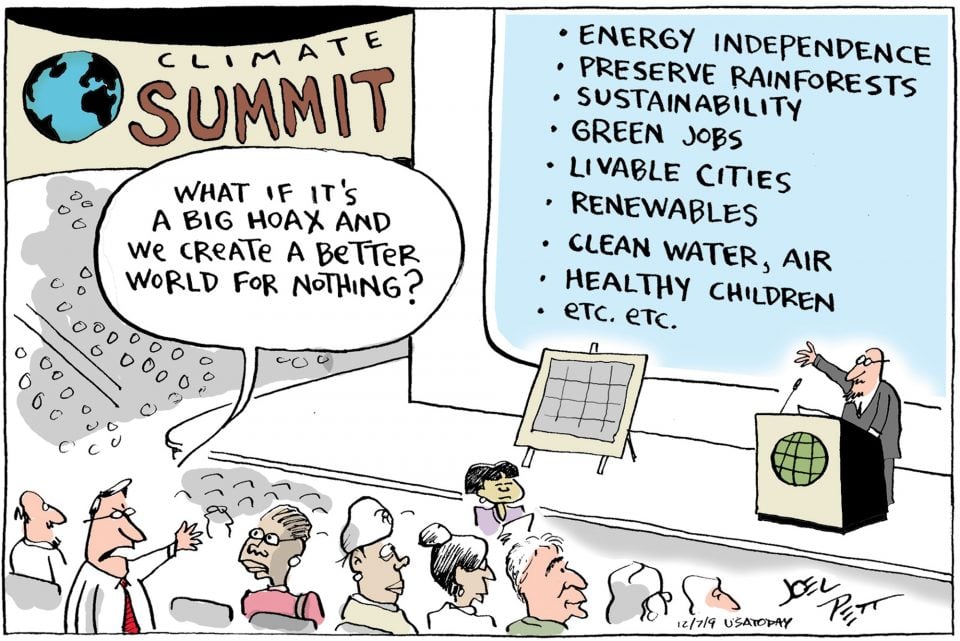
I’m a big fan of protecting our environment but this fails because it’s a straw man.
Everyone knows that the things we get far more than “nothing” from our rampant pollution. We get fast transportation, abundant food, and vast material wealth.
If we were really giving up “nothing” it would be an easy choice. Very few people would be willing to pollute just for the sake of polluting. Even if we only got a little bit of benefit from pollution there would still be incentive to pollute.
Instead we get a ton of benefit out of pollution and we’d have to give them up if we wanted to stop polluting.
The more honest take is that polluting activities have a tradeoff. If we keep polluting at our current rate, we’ll eventually push the ecosystem to a state where it can’t sustain us. We need to be willing to make some hard sacrifices to prevent that and we need to identify those sacrifices, rather than pretending they don’t exist.
Quite a lotta opinions people have on this comment chain, lemme throw mine in too while the gettin’ is good! Also Tl;Dr: We can fix it, but think of the shareholders!
I’ve come to interpret a lot of these modern problems and solutions as questions of capital. To sound like a broken record, having as highly capitalist of an economic system as we do creates a lot of these incentives, so much so that I feel the question itself isn’t necessarily a question of climate policy, but rather a question of our relationship between company and government. Partially because we have a cyclical system of: company lobbies for good law -> good law nets company more money -> repeat, but in the direction of environmental policy.
The EPA exists for a reason, the FDA exists for a reason, basically all three letter burecracies exist for a reason, It’s to preserve something that is found to be important. Increasingly though, companies are exerting larger and larger power on government, and that’s serving to pursue their interests, which in many cases means reductions or cuts to these agencies that can get in their way of profits.
I’m curious why you see my comment as a defense of shareholders?
The beneficiaries of faster transportation, abundant food, and vast material wealth are the consumers. The shareholders only benefit indirectly in that they can take their money and consume goods and services that others have produced.
That’s a tradeoff that happens no matter what economic system we choose. I’m also not even suggesting that we pull back on addressing climate change; I’m saying that this is an ineffective way to advocate for it.
Youre presupposing that were losing something by cleaning up the environment. As if we cant invest in a cleaner environment the same way we spent money of the other things that made the pollution. Its absolutely possible to have all these things.
The point is that we are ALREADY paying more for living in a polluted world than a clean one. Pollution causes so many widespread health problems that we’d make that money back on healthcare costs alone.
Thats what makes this environment discussion so nonsensical. We dont even have to address climate change to get a return on our investment in cleaning up the world.
I think you misunderstood the meaning of nothing. I think the idea is not that you have to give up nothing to create a better world.
I think it means that all those measures to fight against global warming would create a better world even if it turns out that global warming was really just a big hoax and the fight against it was for ‘nothing’.
Rather than argue semantics I’d rather rephrase the same statement using different words in the hopes that that removes confusion.
The comic essentially argues that we can fight climate change at no cost. That’s nonsense. The cost is there and it’s quite steep. The better argument is that even the high cost is worth it because the cost of not fighting climate change are much higher.
Thats literally the opposite of the point of the comic.