
You must log in or # to comment.
B.
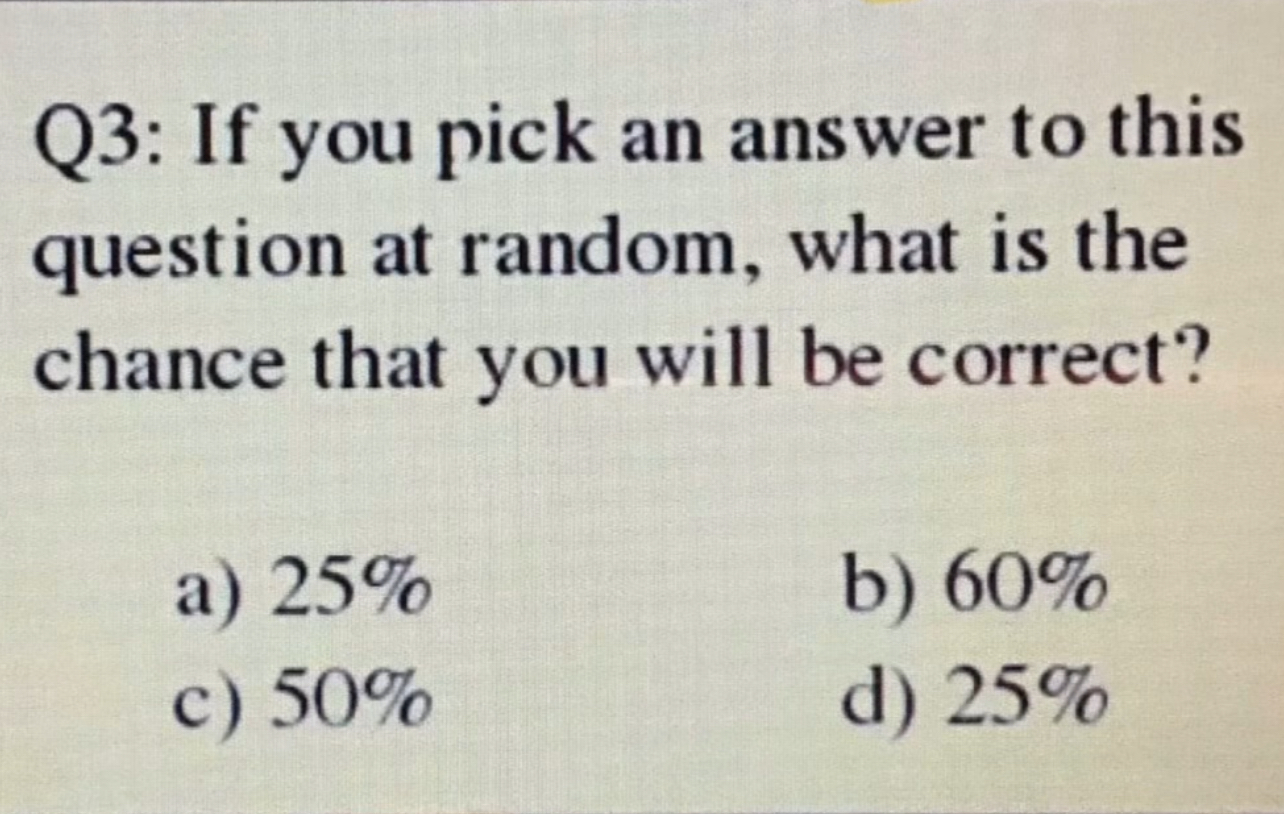
This is a multiple choice test. Once you eliminate three answers, you pick the fourth answer and move on to the next question. It can’t be A, C, or D, for reasons that I understand. There’s a non-zero chance that it’s B for a reason that I don’t understand.
If there is no correct answer, then there’s no point hemming and hawing about it.
B. Final answer.
I love this, it shows how being good at (multiple choice) tests doesn’t mean you’re good at the topic. I’m not good at tests because my country’s education system priorities understanding and problem solving. That’s why we fail at PISA
This is a self-referential paradox — a classic logic puzzle designed to be tricky. Let’s break it down:
Step-by-step analysis:
-
How many choices? There are 4 possible answers, so if we pick one randomly, the chance of picking any specific one is 1 in 4 = 25%.
-
How many answers say “25%”? Two.
-
That means the probability of randomly choosing an answer that says “25%” is 2 in 4 = 50%.
-
But if the correct answer is 50%, then only one option says “50%” — which is ©. So the probability of picking it at random is 1 in 4 = 25%, contradicting the idea that 50% is correct.
-
If the correct answer is 25%, then two options say that — a and d. So the chance of picking one of those at random is 50%, not 25% — again a contradiction.
-
Similarly, if 60% is correct (only one option), then the chance of picking it randomly is 25%, which again makes it incorrect.
Conclusion: Any choice leads to a contradiction. This is a self-referential paradox, meaning the question breaks logical consistency. There is no consistent correct answer.
-