• 0 Posts
  • 274 Comments
Joined 3 years ago
cake
Cake day: August 27th, 2023

help-circle


  • I find the linked Software For One more interesting.

    That is how personal computers were intended to work - and why so many booted into BASIC. Anything that lets you turn intended rules into running code lets you Manfred Macx that shit and outsource it to one of the computers you wear. It doesn’t need to cost anything, if you run it locally on a computer slightly larger than that.

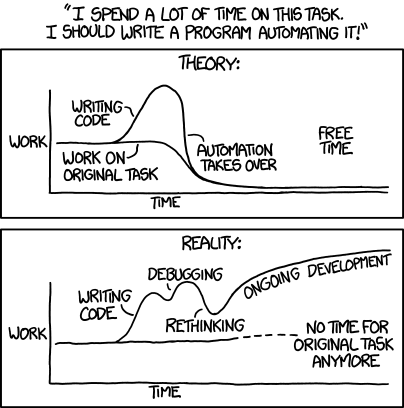
    This shift potentially elides that one XKCD about automation… or else drastically expands which minuscule tasks you’ll accidentally spend more time automating.

    That said - god damn would it be nice if modern HyperCard was an immediate option. Visual Basic and Flash built so much shit because anyone could just open it up and go. The bastard zaibatsus behind modern phones don’t want that, because they make billions forcing their app store onto everyone. Even writing a single-page HTML application for your own goddamn phone is treated as a threat… because it is.


  • Astrology is complete bullshit.

    So is a monopoly app store censoring astrology.

    You have a moral right to run whatever the hell software you want, on your own hardware. It’s not ‘their platform.’ It’s your computer. That’s what the money was for.

    You want a glorified Magic 8-Ball program treated the same as pornography? Fuck you. And your phone shouldn’t deny you pornography, either.

    Certain kinds of apps, such as dating, flashlight, sound effects, wallpaper, simple timers, and fortune telling, are well established on the App Store and we will not accept new submissions unless they offer a meaningfully different or improved experience.

    … oh my god that’s worse. It’s a No Homers rule. How does Apple suck so much that grandfathering sounds worse than ex post facto exclusion? You can’t declare entire classes of software inherently unworthy, to be excluded simply for being that thing, and then also use ‘we have sufficient examples of that thing’ as justification.


  • What bugs me more is logarithms. You just multiply a fraction over and over. It’s counting multiplications. Even the Babylonians had something called logarithms, but that used tables for some trigonometric identity, probably slower than longhand multiplication of several leading digits. (Or just one leading digit, since their number system was base sixty. Have fun memorizing that times table.)

    Yet the modern form didn’t show up until 1617. Even that was almost accidental, developed as a kludge for solving a different trigonometric problem. Except that kludge was backwards, using base 0.999 etc in 1614. It took only three years for another mathematician to figure out base 10 would be massively simpler. By 1620 another mathematician had drawn that as a line and recommended a compass for easy math. By 1622 someone had slapped two of those together to form a modern slide rule. By 1630 those were everywhere.

    We should’ve been finding those things all over antiquity. Even cultures that had never been taught with them would have occasional bright sparks pick one up, fiddle around, and go “Oh… oh! OH!” And yet: it simply never happened, until well into the age of sail. The Romans understood compound interest so well that it was strictly illegal. They had percentages; they’re where “per cent” comes from. And before them, there’s cuneiform tablets figuring out the square root of two. Arabic numerals, which openly invite what we call scientific notation, were developed in the late 800s, and by 1000 had spread to the god-dang Pope. And it still took six hundred years for someone to figure out you can scrunch up the digits around a circle, with pi almost at 180 degrees, and save so much time fiddling with your abacus.


  • destruction of art at the industrial scale

    One copy. One copy of each book. And they’re not doing sexy vault heists for the last original manuscripts, they’re just buying antiquarian junk by the ton, through a service that avoids giving them duplicates. If this process is a threat to the preservation of any particular work, it’s probably because that work is undesired by anyone else in the world. Its eBay listing would end with zero bids. If it wasn’t going from a warehouse to a scanner to the dump, it would likely go straight to the dump.

    If you want this process to aid in general preservation, maybe take aim at how Anthropic got fined over a billion dollars for infringement. That’s their motivation for doing this - that’s the kind of money they risk if they share all their super-rare scans. Of garbage.


  • When the bubble bursts, this tech isn’t going away.

    Last year some blog recreated GPT-2, the first LLM ‘too dangerous to release!,’ for twenty bucks. Corpus to model within the hour. The billions spent on research since then have let newer models of similar size benchmark a hair below the big-iron cutting edge.

    I recently found out Chroma, once a leading image model, was made by like two people, for presumably $200,000. Not nothing… but within reach of even small organizations. Recent pressure has been toward making models even smaller and less structured than that. Several updated video and editing models have quietly declined to release their weights, because they’re small enough and powerful enough that most people would just run them locally. That desire, and that potential, will not vanish for wishful thinking.

    If models had to train on nothing but public-domain, BSD, and CC0 materials, they’d still work the same way. If the money dries up to-morrow, then what’s possible with hobbyist research alone will continue. If even they hit a brick wall, barely past current capabilities, that’s still a couple gigs of linear algebra that’ll try and do anything you ask.

    Meanwhile - people will still make art. People make art even when it’s illegal. Photography didn’t stop anyone from drawing.


  • They can’t resell it, or their scan isn’t a “backup copy,” it’s just piracy again. Same reason they can’t share their scans of apparently-rare books nobody’s cared enough to put on Archive.org.

    Cutting the spine off is the simple way of scanning a mass-produced book. The alternatives are Rube Goldberg devices, or abundant tedious human labor.

    What are you asking for, if not this? A private library of obscure forgotten works? A warehouse full of carefully-preserved dead weight? This was always the immediate alternative, and we told you as much, when y’all huffed about simple piracy. Like the average person on Lemmy gives two shits about piracy, outside this context.


  • One. One copy of of every book. (Per company, but still, it’s a narrow field.)

    They’re not seeking out antique dusty tomes for a king’s ransom. They’re checking off ISBNs for anything that got published. That’s usually only rare when nobody bought copies because nobody cared. Anything older than Steamboat Willie is on Project Gutenberg, free for the taking.

    And I remind anyone still cross - if you’re against them just using torrents, this is what you’re asking for. This is the completely above-board alternative, done in a sensible manner.


  • Every fucking week with this story.

    • They used scans “found online” and people bitched as if piracy is theft.
    • This workaround is the same as ripping your CDs to MP3.
    • They can’t just donate the book because then it’s not ‘a backup copy,’ it’s piracy again.
    • They’re only buying one of each book.
    • If it’s old enough to be public-domain they don’t bother.

    Stop posting pearl-clutching headlines like it’s a library firebombing campaign.