
You must log in or # to comment.
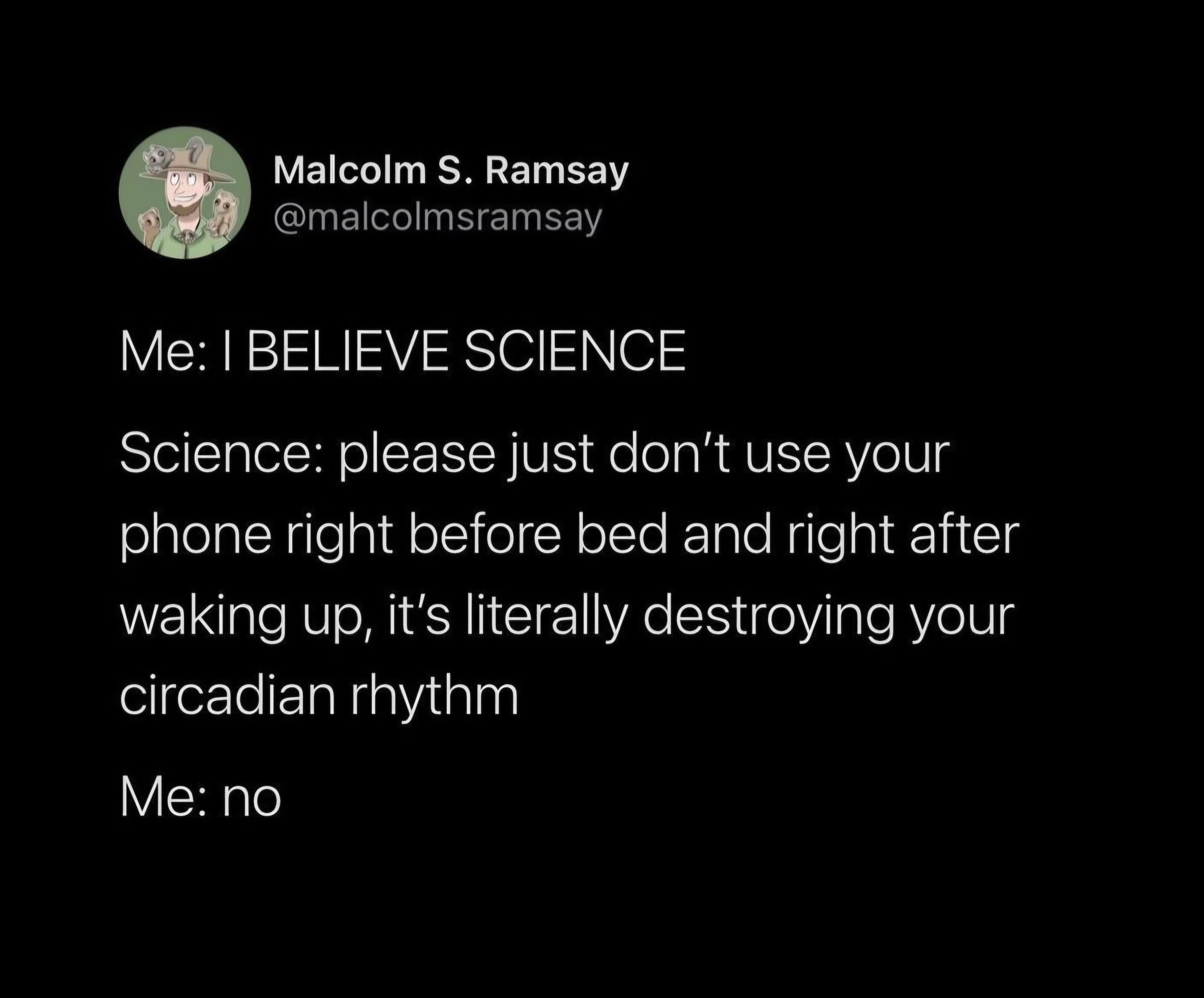
I mean, those two things aren’t mutually exclusive. I can believe the science AND ALSO engage in behaviors it says are unhealthy for me.
I have night light mode on my phone. So I’m good!!!
That’s not a scientific thing tho ! Proven to have no effect in fact.
Apple wouldn’t lie to me.
Proven to have no effect in fact.
I thought the blue light was the problem.
Proven*
Samples sizes are always small, confounding variables poorly controlled and control groups often contaminated.
Long term effect are also poorly studied.
I agree. I believe science but I seriously think the BIPM (Bureau International des Poids et Mesures) is wrong. They made SI bad by glossing over the necessary base unit of angle, there should be 8 base dimension, not 7.
Except it’s not a unit, it’s a unitless ratio. You’d have one for every number of dimension. The mol is arguably the extra one.
I seriously disagree with you, your you’re wrong.
here’s an article which supports my reasoning https://arxiv.org/pdf/2108.05704
No one stops you from putting radians and steradians in your units. But it’s unitless by definition.
I strongly disagree with the definition itself. And yes, there are stops that prevent me from doing that in scientific computing resources like sympy, matlab, and my professors.
You disagree that a ratio is unitless? What’s the cos of a unit?
I get why you shouldn’t use it before bed but why not after waking up? If it keeps you awake shouldn’t it help you wake up?
allegedly
you are priming your brain for distraction
that info comes from Julie Morgenstern, an organizing & productivity consultant, so I dunno how scientific it is…
Also, it’s forbes
God damn, I can’t find any solid research that backs up the claims of it being bad for you, granted I didn’t do a thorough search, but I did still look and came out empty handed.
Just after you wake up, for about 30-60 minutes, you’re in a state known as sleep inertia. The CDC recommends not doing critical tasks during this period, but that could just be because it affects performance. They do also say that bright light can more quickly restore performance, which a phone screen most certainly is.
So, let’s look into it a bit more. Granted, I can’t find anything more than a couple psychologists saying this, so take it with a grain of salt, but it seems like it mostly does come down to you priming your brain for distraction, as was initially stated. You have the least amount of built-up fatigue when you wake up, but if you go on the app that is designed to take as much time and attention of yours as possible, then you are giving away your least-fatigued time of the day to social media, before you do anything productive.
The more things you do in a day, the more fatigued your brain gets, and the harder it is to actually get other things done afterward. On top of that, it can also just be a behavioral thing. If you repeatedly get on your phone every time after you wake up, you are telling your brain “waking up = get on phone,” and not something like “waking up = get out of bed and brush teeth” or “waking up = get breakfast.”
This can build a dependency over time, which then leads you to, as previously mentioned, taking the time you are least mentally fatigued, fatiguing your brain with high-speed flows of information, and only then actually expending the remainder of your energy on everything else you need to do.
That is under the purview of my field of science (Industrial Organization Psychology), so it can be plenty scientific. However looking at her bio she is not an IO psychologist and has no formal training on the subject so take anything she says with a grain of salt.
That’s a good way to start my work day then because I’m constantly moving from one fire to another.
This stuff is sciencey, not science.
Just because I don’t follow the recommendation doesn’t mean I disbelieve it. Science also says I should eat better and exercise more and do less drugs 🤷♂️
Drugs are made with science
counterpoint:
The first reliably documented report of Psilocybe semilanceata intoxication involved a British family in 1799, who prepared a meal with mushrooms they had picked in London’s Green Park
Fascinating! I looked up that 1799 report - here’s the link for anyone else interested.
It’s true in that almost every food item is made “with science” (university-educated food technicians, biochemists, engineers etc.) these days, but you hardly need science to make common drugs like alcohol, caffeine or nicotine. Coffee and tobacco are just plants, and fruit will spontaneously start fermenting all on their own.
It’s actually neutral on the subject of what you should do. That is for medicine and public health policy, or even personal choice.
some things we do just to see how bad they’ll make us feel
Just because I believe doesn’t mean I listen.
Science is totally right here, I have no doubt. It’s just… that I have zero regard for my own health.
Me trying not to murder my partner who I love very much when her phone suddenly blasts out Instagram brain-rot at 11pm and I’m trying to maintain a vaguely healthy bedtime ritual.
Me using phones : wow, I can sleep at 1am, great.
Me “just going to bed” : great, it’s 4am and I’m still overthinking my shortcomings!Yep. Numbing the thoughts away with constant input helps the body gain the upper hand and let me go to sleep.
Yeah this is me as well. I just overthink for hours without a distraction. Give me a phone or something to watch and I’m out in 15 minutes honestly. I feel bad because I know I’m probably degrading my sleep but…as least I’m sleeping.
I recently tried audio books and they worked surprisingly well for me. I tried some of those “bedtime stories for adults” at first but they were kind of lame. Stephen King’s short story collection Nightmares and Dreamscapes did the trick. Just speaker on my phone and set to read one chapter, ~1 hour in this case.
I feel a little scared imagining that lol. I gotta have my bob ross everything is fine scritch scritch happy clouds.
Yea I’m a weirdo! My dad owns pretty much every Stephen King book, so I started reading them in middle school
I believe what science is saying. I’m just not going to follow it. If I try to sleep without reading something my brain will start ruminating on things and then I’m definitely not getting to sleep. All my reading materials are on a screen.
It’s not a settled issue. There are research papers that show evidence that blue light affects sleep, which is not the same thing as blue light makes your sleep worse.
So does it make sleep better?
It’s associated with dim light you see naturally at dawn and dusk, so it makes sense that it has some effect. But exactly what isn’t clear and it might be a lot of it depends on the circumstance.
I tried buying more physical books. I have a small stack of it, but I can’t motivate myself to actually keep reading them. And there’s always the danger that I find a page turner that’ll keep me reading the entire night …
I just listen to podcasts at a volume low enough that I have to try to listen, tires my brain out
For me i trained my mind to quiet when i hear wreck of the edmund fitzgerald. I also use sleep talk down videos, audio only, to distract my brain long enough for sleep to strangle it into submission to avoid yhe darkness.
What’s this about right after waking up? (I may have struck this from memory)
My circadian whatever has had all my life to get used to it. I don’t accept complaints now.
Small rant, but people saying they believe in science is a pet peeve of mine. Belief has no place olin science.
You can’t “believe” in science any more than you can “know” in your religion.
Belief and faith are the realm of the unknowable. Knowledge and fact are the realm of science.
When people say they “believe” in science, I think they mean they are putting their faith into the scientists performing the science. That whatever conclusion they come to after an experiment or study is the correct conclusion.
I’m sure you can find the flaw in doing so, as science is constantly being debunked. A good example that comes to mind is the alpha wolf theory.
It can be argued that while science strives to be in the realm of knowledge and fact, it doesn’t always succeed in doing so. At least not in the first rounds of study. And I think that’s what its strength is; being able to correct itself in the pursuit of knowledge and fact. All the same, science is run by humans, and humans are fallible. But despite that fallibility, some people are willing to put their faith into scientists because of their constant pursuit for the truth. Even if what they said yesterday got debunked today, it doesn’t make yesterday’s scientists any lesser. It only means we are all better for it.
When people say they “believe” in science, I think they mean they are putting their faith into the scientists performing the science. That whatever conclusion they come to after an experiment or study is the correct conclusion.
That’s literally what they mean, where “scientists” may as easily mean real scientists as charlatans.
It’s still completely antagonistic to how science is practiced (if scientists behaved like that, they would never learn anything), and something closer to religion than science.
I think they mean they are putting their faith into the scientists performing the science
It’s not just the scientists, it’s the whole process. You trust that the journals are selecting articles based on their scientific merit. You trust that the journalists reporting on the stories are doing their best to accurately summarize the scientific articles, and that if they get it wrong they’ll issue a correction. You trust that when science makes it into textbooks that those textbooks are accurately summarizing and maybe simplifying the science in a fair way. You trust that teachers or professors who are explaining the science to their students are doing it faithfully and accurately.
The Alpha Wolf theory shows how that sort of thing breaks down. There was a scientific study, and at the time there was no reason to suspect it wasn’t legitimate. The scientist who did the study was accurately describing what he saw. The journal that published it had no reason to doubt it was good science. The peer reviewers did their job well. It just turned out that he was studying captive wolves, and that wolves in the wild didn’t behave the same way. Unfortunately, “wolves live in family units where the parents are in charge” isn’t as interesting a story, so while scientists have been trying to correct the record for a while, there are still people who have been taught by “science” or at least “the modern media and educational system with science at its base” that think that there are “alpha wolves” who take charge of a pack based on being strong and aggressive.
they are putting their faith into the scientists performing the science.
This anti-science ideology is usually called scientism.
I am not smart enough to come to my own conclusions about a lot of science, so yes I must believe what the collective scientific community asserts, because I have no other way to prove things that happen. For me, that means putting my faith in their accuracy. So yes, I believe in science.
It should also be noted that there are people out there that treat science as a religion; that it is infallible, and cannot be changed, and to suggest otherwise is blasphemy. 🤷♂️
No you don’t have to believe whatever you hear. You can be critical instead. You can also accept the results of science up to the boundaries of the results presented. Etc. There’s absolutely no need for faith.
yes I must believe what the collective scientific community asserts… It should also be noted that there are people out there that treat science as a religion

https://www.merriam-webster.com/dictionary/believe
“To consider to be true or honest”
I don’t know what you think believe means but you’re wrong
Literally the second definition “To hold as an opinion”
Ah, if it’s one of the definitions, it must be the only definition.
You can believe that an answer can be found scientifically. You can have faith that what you see with your eyes, and that what happens during experimentation is accurate and not a fluke or trick of some sort.
Just because religion dominates most belief, and there are strong religious groups that hold that belief and faith are binary with no wiggle room whatsoever does not mean that it’s the only way they can function. On can still test faith and belief without losing them, and changing those beliefs to what holds more truth.
Holding that that belief and faith have no part in science… is a belief in and of itself. A particularly contradictory one at that.
Sounds like someone needs to spend a day or two going down a wikipedia rabbit hole about the concept of knowledge.
Knowledge is itself a justified true belief. Also, the scientific method is the best way of obtaining empirical knowledge, but the idea that empirical evidence is true is still a belief, and not even that justified. Also also, science is constantly trying to prove itself wrong. It’s unlikely that what we think now based on scientific methods will be the same we think in the future.
“believe in” religion
“understand” scienceHello, Ordo Machinum? This heretic right here!
You were doing good until the very end…
Knowledge and fact are the realm of science.
No this is wrong too. Evidence and probability are the realm of science.
im not a cicada. i do not concern myself with these matters.
I have Delayed Sleep Phase Syndrome… light has no effect on me. Checkmate scientists!
I have a strong feeling I do too, inherited from my mom (both of us self-diagnosed). I also appreciate you calling it a syndrome and not a disorder. It’s only a “disorder” because society decided to only accommodate one type of circadian rhythm. Humans have needed people on night watch forever, my money is that this was an advantageous phenomenon.
Me too!
Question: does your schedule slowly morph and change over time or does it stay consistent?
Because I think I have non-24 on top of it and I was wondering if it was part of the normal symptoms or not.
If I let myself I will easily fall into a 28-30 hour cycle and end up only going through 5 or 6 “days” in a week.
Yep. Sounds about right! Sucks, I’m sorry.
How were you diagnosed? I’ve experienced a similar difficulty keeping a consistent sleep schedule but I’d always assumed it was screen related
When it didn’t go away when I was temporarily taken off my adhd meds as a teen. Before that they thought it was just because of the meds. That was apparently also the earliest indication that I would have adult adhd. If you have an adhd doc talk to them about it, it’s pretty common to have both.
More evidence that confirms my personal theory that I do have at least a touch of ADHD. Not sure going through the whole process of diagnosis would help me any though
Not OP but I was diagnosed by being sent to a sleep specialist. I complained of fatigue to my PCP so they checked me for sleep apnea and during the initial meeting I described my schedule and what is typical for me. At the end of the questioning I said “yeah, I’ve suspected I have a sleep disorder or something” and she said “you definitely have delayed sleep phase disorder” and BOOM it was in my chart.
Easiest diagnosis ever. It helps if you keep a sleep log for a little bit. I can’t guarantee the ease of your diagnosis but mine was just being honest instead of lying and pretending to have a normal day walker schedule.
If’s hard to believe when my circadian rhythm was still fucked long before I had a screen I could take to bed.
I believe science, that’s why I use my tablet instead