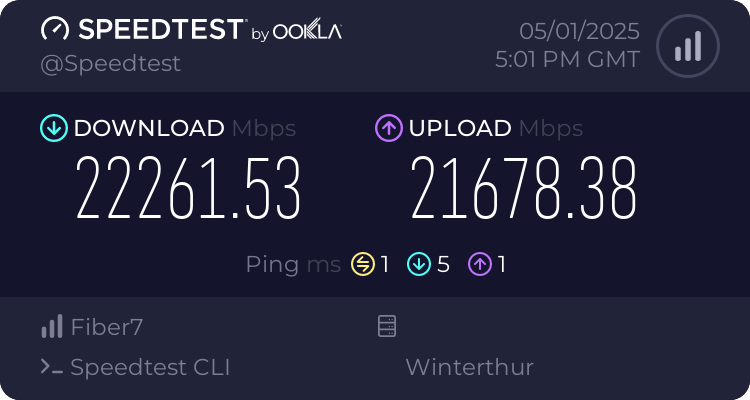
Now look at Switzerland. Here, the physical infrastructure, the fiber in the ground, is treated as a neutral, shared asset. It’s built once, often by a public or semi-public entity.
Every home gets a dedicated 4-strand fiber line. Point-to-Point. Not shared. Not split 32 ways.
That dedicated fiber terminates in a neutral, open hub. And any internet service provider can connect to that hub.
Init7, Swisscom, Salt, or a tiny local ISP, they all have equal access to the physical line that goes into your home.
But that’s communism!!1! /s
Which is funny because Switzerland is probably one of the most economically liberal country in Europe.
Based on secret nazi gold and “banking secrets” (taking care of illegal funds).
The Swiss are no angels.
Also, what do you do with > 1gbit fiber??
I move large datasets for various projects. We also have some servers that get surges of activity (see: my kids run game servers with friends sometimes).
Having high speed fiber to the home has been great.
Oh, and the latency is much more consistent. On cable or dsl I often experienced many more laggy transmissions and packet retransmits.
I have 1gb/0.7gb fiber and do similar stuff. Latency is golden and speed is top notch according to me. I actually have 5gbps (2.5+1+1+0.5 or something, Also 10Gb is just +10€/m) but it’s just expensive to replace my old ethernet cables & routers IMO for bo gain.
Sometimes it’s not about what you can do now, but in the future.
Some months ago I’ve watched a documentation about a small village in Germany with abysmal internet access and how how multiple companies there struggled to do any work beyond being a bakery.
There was a construction company pre-building blocks for houses out of lumber and their CNC machining required stable internet access. They weren’t able to work for days because of fluctuations.
I have a one gigabit line here at my home and even I struggle sometimes uploading bigger assets to my company’s servers.
I like the approach Switzerland went with. If you tear up the road, put down the most modern infrastructure available at the moment. Don’t bother with “good enough for the moment”.
Bet that bakery didn’t have a measly 1gb fiber though, so it’s not really relevant IMO.
Also, what do you do with > 1gbit fiber??
More than 10 years ago, Australia started rolling out it’s national broadband network. The original plan was for fibre-to-the-premises for every dwelling in the country. The governing party that came up with the idea was voted out for other reasons, the conservative party(s) - a coalition of two parties - gained power and stripped it back, it would be fibre-to-the-node for the majority of the country, with some places gaining fttp. or fibre-to-the-curb. Before this it was (mostly) all copper wiring and ADSL. Speeds were supposed to be close to gbit, but the conservative party questioned that, like you have, why would we need more than 20mbit speeds. Nobody needs those speeds citing this, as well as costing issues the conservative party ended up spending more to deliver less. Years later, when future reality hit everyone in the face with how internet-centric the world was becoming there were plans to bring forward fttp to all dwellings in the country, costing more. So, instead of just sticking with what was originally planned, which would have future-proofed the network for some time, they ended up spending more, to deliver less, then ended up costing more to finish the job as was originally intended. Which still isn’t finished yet.
It should also be noted, that when announcing the changes to the planned network, the conservative government chose to do so at Foxtels studios. Foxtel is Australia’s largest (pretty much only) cable/satellite tv provider. Foxtel, being listed on the NYSE had disclosed to investors that one of the risks to its business at the time was the upcoming NBN, given the apparent rise of Netflix, and other online streaming entertainment. Now of course it’s not fair to suggest any link between the two events, as it also isnt fair to suggest that cost blowouts wouldn’t have occurred had they kept to the plan. However, the facts are, they bastardised the plan, it cost tax payers more money, it required rework less than a decade later, and it still isn’t up to the level it was originally intended for.
Should be noted that the conservative party is also the party that cut ABC funding (Australian Broadcasting Corparation - the public broadcaster. least biased. Most attacked by cuntservatives). Meaning the ABC couldn’t afford to produce Bluey solely on their own, meaning they had to sign deals with BBC and such, which gave the BBC full merchandising rights. So, given Bluey is an Australian created world-wide smash hit, not one cent goes back to australia (minus anything from the original creators). So again, the fiscally conservative party, screwed over the people again. Then had the audacity to attack the ABC for the bad deals created for Bluey.
Massive tangent there, I apologise. However, my main point was, the majority may need more than 1gbit, or more than a couple hundred mbit right now, but it will at least be future-proofed for a good while, saving more money in the long run.
Excellent justification for my constant desire to punch Malcolm Turnbull repeatedly in the face.
That cockhead set back the entire country a decade just so he could knife the PM and get 15 minutes in the top chair before getting knifed himself.
God I hope he falls over on the shower and lands anus first on a shampoo bottle.
Interesting read! But still doesn’t address my question!
I’m on 1/0.7gbps since IDK almost 10 years? Family, Minecraft servers, I build P2P stuff, we all watch videos and so on.
As I explained elsewhere, I’m actually on 2.5gb(+1+1+.5 or something) but havent felt the need to upgrade my local 1gb network. 10gb is only +10€/m too if I need that.
But I don’t, so I wonder what people would/is use it for, not if 20mb is enough 😁. Were mostly even on wifi, and that’s only 0.6gb…
Also, what do you do with > 1gbit fiber??
instead of saving anything to a hard drive you just keep a constant stream of download <-> upload going to keep the data in the tubes
Fantastic 😁!
maybe they can say internet freedom
Also, what do you do with > 1gbit fiber??
:-DDD obviously a question from somebody without a good Internet connection, it maybe it needs /s at the end?
I suppose they can do about 25x more. But that’s just my bad math.
Both “doing business with the OG Nazis”, and “helping the oligarchs hide their money”, are common features of (neo)liberal governments, yes.
It’s enough to make you cry. They probably pay less too.
I live near San Francisco and I pay like $55/month for Sonic fiber. It’s 10G down, 10G up, which is absurdly fast for me. Almost all my devices can only use 1G so I definitely don’t need 10G. I was just so fucking sick of Comcast, I was paying quite a bit more for 1G from them.
My ISP bumped me up from 1GB to 3GB for free and I was like like great, can you upgrade all of my NICs and router ports to be higher than 1GB? Because you effectively gave me nothing.
A lot of people in here saying they have no use case for it, but if everyone had this kind of connection then the use cases could start to emerge.
When I briefly had really fast fiber, the noticeable latency difference was insane. It’s not enough to go by a simple ping. Nobody uses the internet by sending pings. Real world use is about moving a lot of data. A more accurate measure of latency is bandwidth. Everything loads instantly. It’s like going from HDD to SSD or single core to multicore CPU. I probably rarely max out the bandwidth of my modern SSDs or CPUs but they’re just faster.
Also it seems like a lot people, especially Americans, cope about everything they aren’t the best at. Tell themselves they don’t need it. What’s it for? It’s useless. It sucks anyways. They don’t want it… Like immature little kids. When they have the thing then suddenly everyone else sucks for not having it.
Back in 2008, when the industry sat down at the Round Table organized by the Federal Communications Commission, it was Swisscom, the incumbent itself, that pushed for the four-fiber Point-to-Point model. The company argued that a single fiber would create a monopoly and that regulation would be necessary.
So the standard was set. Four fibers per home. Point-to-Point. Open access for competitors on Layer 1 - the physical fiber itself.
Then, in 2020, Swisscom changed course. The company announced a new network expansion strategy, this time using P2MP, the shared model with splitters. On paper, they argued it was cheaper and faster to deploy.
…
Swisscom fought this all the way to the Federal Court. They lost. In 2021, the Federal Administrative Court confirmed COMCO’s measures, stating that Swisscom had failed to demonstrate “sufficient technological or economic grounds” to deviate from the established fiber standard.5 In April 2024, COMCO finalized its ruling, fining Swisscom 18 million francs for violating antitrust law.God damn
It’s like a whole other world
https://irregulators.org/200-billion-broadband-scandal/
TLDR; $200-$300 billion fraud committed by American telecoms in the 90s because of corruption, deregulation, and shady business practices - set the US back decades technologically and economically.
Switzerland can be driven from top to bottom in about 4 hours. The entire country. It’s tiny. That’s how.
Most European countries have 10G, it’s nit about the country size. And it’s mostly in the cities anyway, which just completely remove the “the US is too big” defence.
It’s absolutely about scale. It’s super easy to build high speed fibre to every house when your entire country can be seen in a single day trip. Not so much when it takes a week to drive from one side to the other without stopping.
Most European countries are tiny.
Europe is about 10% larger than the US, if you exclude Alaska.
Yeah, and Europe as a whole doesn’t have this internet. Switzerland does.
That wasn’t the point, you said most countries are tiny.
But as stated before, many countries has 10G or more.
Most European countries are tiny.
Europe isn’t a country……you know this, right?
You realize that each state in the US can be seen as a country too, right? If you didn’t only have a tiny handful of private, greedy ISPs, you’d literally have the same situation as europe, except that country = state and continent = federated states… just because the country USA as a whole is big does not change anything and is just american exceptionalism
The article is about America, as a country, being compared to Switzerland, the country.
What they’re doing can be done at scale. Instead we scream about socialism like monkeys throwing poop at each other.
It can be done at scale, it’ll just cost trillions of dollars.
Laying fiber that supports 200G literally costs exactly the same as fiber that supports 100M. It’s just single mode fiber and when you have it you can run anything over it you want. You can also add expensive DWDM equipment at both sides and run a multi Tbit line over it. Also you can still use it in 25 years.
Building anything else than P2P fiber is just dumb.
cries in Australian
Remember how we were going to have a full FTTP NBN, but then the Liberals fucked it?
Cause I will never forget.
In Romania we have 10gbps in some regions. 2.5gbps is becoming common in cities and 1gbps is the norm everywhere. You don’t have to use Switzerland as a benchmark here!
Beaten by a Third World nation, easily (Switzerland is neutral and was neither in NATO - the First World, not the Warsaw Pact - the Second).
I’m sad this article uses AI images, instead of the obvious choice to show a Comcast employee rubbing their nipples
It’s funny because we actually have three fiber providers where I am now. They all have their own last mile runs, with fiber to the home. And none of them even offer 10Gb. It makes no sense. At this point fiber itself is way cheaper than copper. 10Gb/s switching equipment is cheaper than 1Gb/s was 15 years ago. The infrastructure is literally there, and it’s like nobody cares.
I don’t even have 25Gbit connection to other rooms in my own house. I’m still at 1Gbps all over.
Where are you all getting reasonably priced networking kit from? As far as I can tell it just doesn’t exist…
China. India also rolled out cheap fiber.
Right, but say it’s 25Gbps, how are you going to wire your house to take advantage of that?
Currently I’ve got a couple of 1Gbps 8 port switches dotted about the place. Where is the 25Gbps version of that? There’s absolutely no consumer hardware at all to take advantage of this kind of speed.
Consumer hardware? No. But there’s plenty of used enterprise grade 25gbit networking. Industry has moved beyond 25g to 200+g so the 25gbit equipment is cheap
Check alibaba
Reasonably priced 1Gb kit?? Should be easy to find. Heck, I picked up a 16 port no name switch missing the power adapter for 4 bucks at the thrift store.
Netgesr stuff is still pretty good for home use, at least last i checked. Ubiquit APs aren’t bad (again, last I checked).
No, 1Gb kit is easy. I’ve got a couple of switches all over for that.
Going past that? Only common one is like 2.5Gbps, maybe. Anything else is priced like you’re running an Azure datacentre.
How does 4 strands mean 4 providers?
Can you communicate bidirectionally on just one fiber strand?
Yes. Using different colors of light and polarisation, you could even have multiple connections going over the same wire/fibre.
How do I even ask an ISP if a fiber network is shared or dedicated?
I don’t know the words, and the sales reps probably don’t know either. I don’t live in either Europe nor North America.
I’m willing to pay $10,000 for a dedicated fiber line that’s shared by no one else, but I literally don’t know how to explain what I need when I call the ISP.