The thermal conductivity of a material is a measure of its ability to conduct heat. It is commonly denoted by k {\displaystyle k}, λ {\displaystyle \lambda }, or κ {\displaystyle \kappa } and, in SI units, is measured in W·m−1·K−1. It quantifies the proportionality between the heat flux (heat flow rate per unit area, W·m−2) and the temperature gradient (K·m−1) in the direction of heat transport.[1] The reciprocal of thermal conductivity is called thermal resistivity.
Materials with high thermal conductivity transfer heat more efficiently than those with low thermal conductivity. Heat transport can arise from different microscopic mechanisms: In metals, thermal conductivity is typically dominated by free electrons, whereas in dielectric materials such as diamond it is largely due to lattice vibrations. Materials with high thermal conductivity are used in heat sink applications, while materials with low thermal conductivity, such as mineral wool or Styrofoam, are used for thermal insulation.


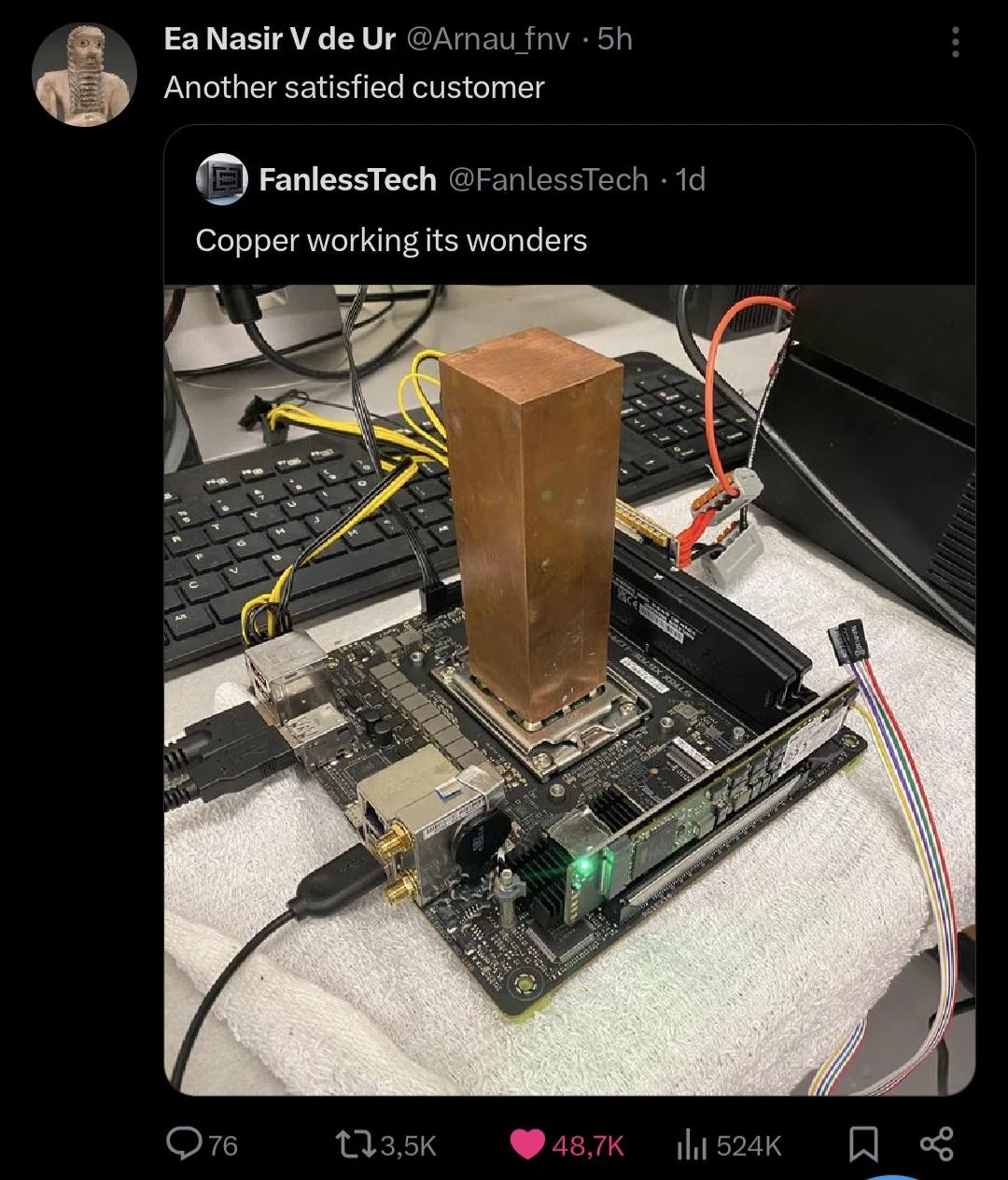
A block of diamond would be even better (copper being at 401 W/mK, Diamond at 3320 W/(mK), almost 10x better)
But only 3-5 diamonds are generated per chunk, requires an iron pickaxe, and usually doesn’t start appearing regularly until Y level 14.
Meanwhile copper can have up to 16 veins of copper per chunk, requires a stone pickaxe, and appears most frequently at Y=48.
Copper is clearly more accessible for making ore blocks.
Wait a sec, this isn’t !minecraft@lemmy.world
Back to the mines with you, you’re yearning
This is after 1.18, Diamonds are most commonly found at Y=-54 now.
with the way prices are going, carbon based heat dissipation may become the preferred option
how pretty would it be if it was a tree-like crystal structure
What’s the K
Gonna assume kelvin
Think C but what if zero was actualy zero
Watts per milliKelvin? I wouldn’t think that would be a form of thermal capacity OR thermal dissipation, which is why I asked
Edit:
Looked it up…
Apparently it’s “watt per meter-kelvin”, a/(the?) measurement of thermal conductivity.
Per Wikipedia ( https://en.wikipedia.org/wiki/Thermal_conductivity_and_resistivity ):
Ketamine
Kooling, obviously
Silver would be more feasible though. It’s next best after diamond.
It has higher conduction but it’s specific heat capacity is worse, at least per mol