
You must log in or # to comment.
How insanely toxic is their poop though?
Well, if it chemically destroys the pathogens, not very.
They squirt shit on their feet like hand sanitizer.
Reminds me of the Sky burial done in Tibet. I guess this way you have also less diseases.
Sadly, due to a certain drug in dead livestock is causing death in vultures the practice has started to have issues. This was a great podcast about the practice and issue: https://99percentinvisible.org/episode/579-towers-of-silence/
There’s a neat Turkey vulture that likes to hang out on the roof of my garage. The neighbors have a wide open field behind my house. I’m pretty sure he lives nearby.
Vultures are metal af.
so you’re saying vultures are basically flying garbage bins?
Compost bins, but yes
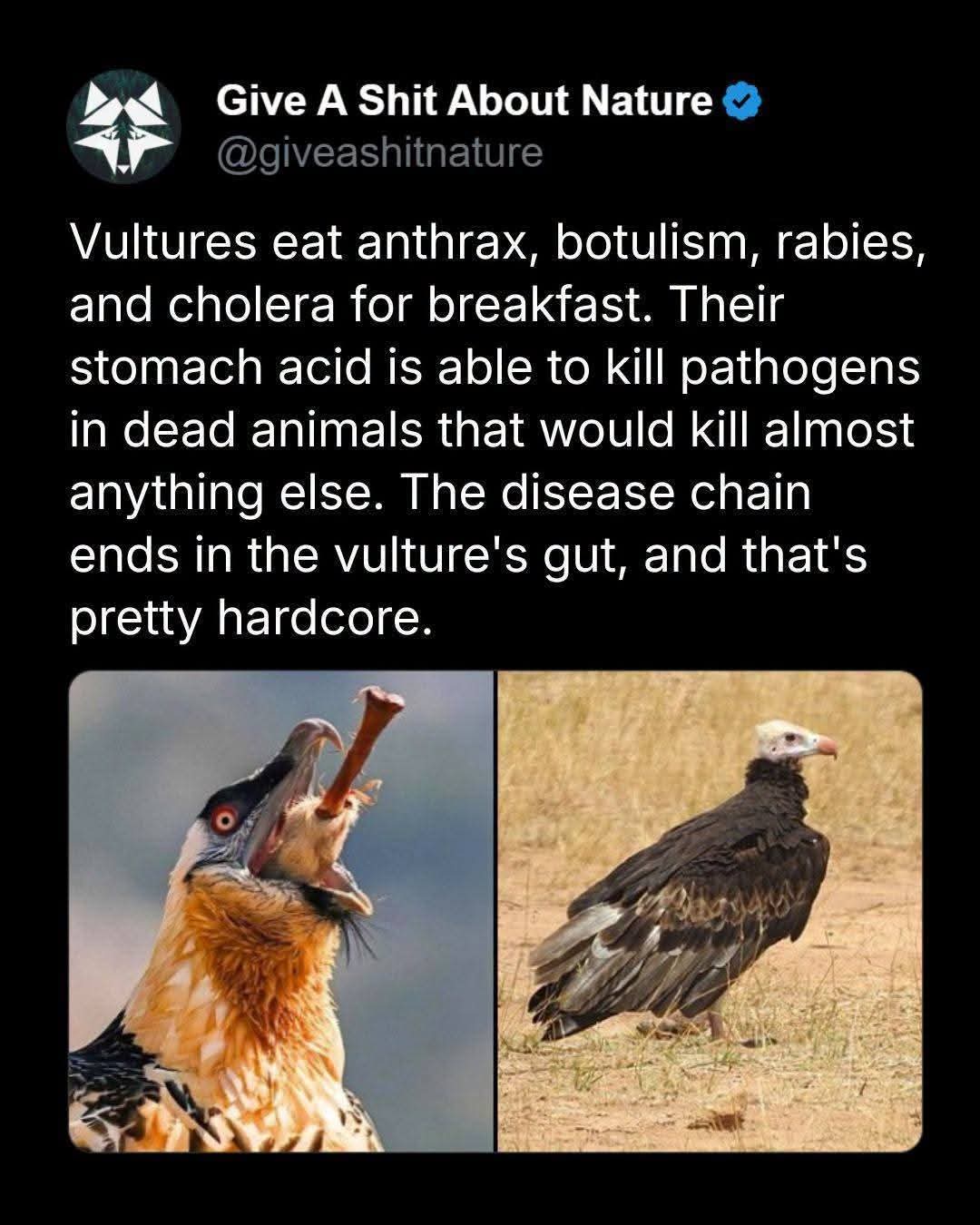
Vultures have been shown to reduce the spread of dangerous infectious diseases at scale.
4 paragraph quote
From this perspective, each vulture species features peculiar skin microbiota compositions, likely involved in singular protective mechanisms of which characterization is yet highly desirable, acknowledging the potential implications under diverse applicative fields. Altogether, state-of-the-art knowledge pinpoints that the cutaneous microbiota constitutes a barrier of microbial, physical, chemical, and immunological nature for the skin [25]. Skin microorganisms represent the first physical barrier against exogenous microorganisms of environmental origin [25]. Here, pioneering microbial specimens promote physical hindrance against the secondary colonization of pathogenic specimens, aside from establishing direct connections with the host, aimed at regulating the differentiation process of keratinocytes [26]. By employing various mechanisms of resistance to colonization, such as competition for nutritional resources, direct inhibition, and/or interference with environmental survival [25], cutaneous microbiota enable, de facto, a microbial barrier that protects from the myriads of pathogenic microorganisms encountered in necrophagic activities [4]. Intriguingly, health-promoting strains of the Staphylococcus genera adopt fine mechanisms to antagonize pathogenic strains of the same genera (e.g., quorum sensing, antibiotic production, etc.) [27,28,29].
…
Vultures contribute significantly to maintaining ecosystem homeostasis. Part of their food intake is released as nutrients through their feces, promoting a cycle of nutrients that supports a healthy ecosystem [90]. From this perspective, efforts in the characterization of the fecal microbiota would elucidate the ecological service necrophagic birds provide to other animal species. Furthermore, vultures have been recognized for their public health benefits, primarily because they can efficiently dispose of vast quantities of inadequately managed carcasses, thereby maintaining adequate levels of hygiene in the ecosystem [5].
The pivotal role of the vultures’ unique ability to contain pathogens is attributed to the microbiota associated with the different anatomical districts of their bodies, with the cutaneous microbiota as the main actor [4]. Unlike other animals, vulture skin microbiota is the most populated in terms of microbial abundance and biodiversity. This is likely due to dietary style, since carcasses carry diverse and more specialized microbial communities, interfering with skin microbial development. It can be hypothesized that the taxa identified derive from the dead animal body, such as Methanobrevibacter smithii present in the intestinal district of the dead animals, or from environmental sources like, for example, Xanthomonas spp. and Actinobacillus pleuropneumoniae [4].
Genes identified in the facial region include elements correlated with putrescine [47], one of the main molecules produced in a decomposing carcass, confirming the influence that the carcass microbiota has on the assembly of the host’s microbiota. Further support for this hypothesis comes from the extensive functional diversity observed in microorganisms residing in the facial region. It has been observed that these range from producers of antimicrobials to normal intestinal bacteria and bacteria linked to plants and soil [4], agreeing that there is a significant influence from the environment and carcass on the composition of the facial microbiota. In this regard, determining the carcass microbiota would be necessary for further evaluation of this hypothesis.
The cleanup crew doesn’t fuck around
I like that account name. It’s not “nature friends” or “interesting nature facts” it tells you to please “GIVE A SHIT about Nature” or fuck off.
And yet they have the mark of shame
Now if only we could bioengineer our own stomachs to be that powerful
There are sure to be tradeoffs which would explain why not every animal have evolved similar stomachs. It’s probably expensive energy wise to maintain that acidity. It probably also makes it hard to maintain a healthy gut flora. Also imagine the burn if you vomit up stomach acid with pH 1.0
Yep, that’s also why cooking food helped us quite a bit with evolving the brain, less energy used to in the stomach = more energy for the brain and muscles
Reminds me of the character “Zeitgeist”.
Also imagine the burn if you vomit up stomach acid with pH 1.0
Instant free ranged weapon!
Betcher’s Gland was present in the Primarchs, we’re looking at around 28,000 years.
Much more achievable for the common man
X-Force!
Yes, but they can projectile vomit as a defense mechanism. Imagine the possibilities.
In the game Mass Effect, the Krogan race has all these “backup” organs. They pretty much evolved to become incredibly resilient.
But they also become alpha douches.
Either way, I love those little guys.
Krogans were heavily inspired by Klingons.
My dog eats a lot of nasty stuff too. If it’s not any good, it comes back up.
That’s one of the reasons humans and dogs created such a good symbiotic relationship. They would eat things, like waste and refuse, that if left around would make humans sick. They got an easy meal and we got protection from food borne illness and rodents.
I remember reading an article once about how difficult it is to make dog food. Because they have to make it appealing to dogs while at the same time not making it so gross that humans would be turned off at the site and smell of it.
Fun fact: rats can’t vomit.
makes sense why rat poison works so well.
Can’t we identify the genes responsible for their stomach formation and CRISPR them unto humans, theoretically giving them the same abilities?
Can’t we identify the genes responsible for their stomach formation
Absolutely.
and CRISPR them unto humans, theoretically giving them the same abilities?
Absolutely not.
CRISPR and related techniques are not magic. The interplay between gene presence and trait expression is absurdly more complicated than that. You cannot simply “edit in” entire biological adaptations, that’s not how it works.
The most likely scenario in such an attempt would simply be nothing. Other possibilities include: Autoimmune lifelong digestive system issues, and death, amongst many others.
To add on to this, vultures stomach acid pH ranges between 0 and 1.
So unless you’re also modifying the stomach and gut tissue to be able to withstand hydrochloric acid I’m pretty sure that (if successful, which is a big if) that person just dies.
Vulture pH is closer to 0.2, ours is closer to 2.
it’s 10x more acidic than ours, so yeah, we would need to probably refine the entire digestive system
~100x it’s a logarithmic scale
I mean, our stomach acid is hydrocloric acid. Just ours isn’t nearly as concentrated.
Considerably less so, but yes I should have specified the concentration
Any sufficiently advanced technology is indistinguishable from magic
Yes. after it reaches a certain point of maturity. Gene editing hasn’t.
We have to start somewhere
And that “somewhere” is optogenetics mice, bacteria that produce egg whites, and glowing fish. Not a complete rewrite of the entire human digestive, immune and microbiotic systems!
Also rabies immunity is because they’re birds not mammals, if you want that; add nervous system and metabolic overhauls as well.
Biggest hurdle to just experiment by randomly crispr-editing in humans are ethical, as a society the majority does not want a repeat of experiments similar to Mengeles twins.
Even though I would love to edit myself to be able to digest lignin and cellulose
Ethics are a big hurdle, but I wouldn’t call it the biggest. Mengele was a conscienceless monster who played at pseudo science.
The biggest hurdle to gene editing is that it’s fucking hard. Even Mengele V2.0 with no morals and a stable of daily test subjects wouldn’t lead to a ‘mastery’ that lets you merely select for your changes to only include digesting lignin and cellulose.
Seriously. It’s really hard to even model within acceptable error margins, what the results of gene therapy will be. The potential for disastrous results also only goes up the more complex the interactions you’re trying to affect.
At current time, even some of the best recorded attempts which are decidedly positively quality of life altering (e.g. [emphasis mine] https://www.science.org/content/article/gene-editing-therapy-made-just-6-months-helps-baby-life-threatening-disease) still come with great caveats:
The boy, first treated in February at just 7 months old, still needs a special diet and medication; the experimental therapy alone isn’t enough to prevent a dangerous buildup of ammonia in his blood caused by a faulty gene for a key liver enzyme. Still, the swift development of a gene editor that appears to have repaired the defect in some of his liver cells is a landmark demonstration of a personalized approach that has tantalized rare disease researchers.
Meanwhile, even renowned institutions starting from best intentions, get it horribly wrong, because the interactions are just that hard to model (e.g. [emphasis mine] https://www.science.org/content/article/exclusive-death-girl-chinese-gene-editing-trial-was-never-made-public):
That vague language glossed over tragedy: Seven days after the girl’s medical team infused trillions of viruses carrying the recipe for the base editor into her spinal fluid, she died of a severe immune reaction linked to the therapy, Science and Retraction Watch can now reveal.
In a possible future, itself perhaps locked in to some other timeline, your dreams may be possible for your grandchildren and great-grandchildren. But today, they’re just as likely to get you dead.
If Im honest I just wish for humanity to be able to treat chromosome issues and lethal fetal issues.
Let trendy transhumanism and cellulose digestion stay on the pages of fiction. I used Mengele as the worst breaker of ethics and horrible practises I could think of
That’s the goal.
Progress is trying to march in that direction. It’s just subtly (I.e, not something PopSci usually covers) one of the hardest scientific undertakings of our time.
I also don’t feel as though neither enough attention nor funding is being directed that way currently.
when you can digest cellulose but you lose 90% of your daily fiber and get colon cancer
Still sounds like a better and more likely survivable outcome than elon musk’s chances of having a positive and interesting interaction with a woman (from the woman’s perspective of course). If that occurs it may create a blackhole.