It’s more that all the interesting things that come from prime numbers don’t really work if you include 1 as a prime. So every time you talked about primes you would have to say “something something prime number, other than 1, yadda yadda”.
For example: The Fundamental Theorem of Arithmetic states that every natural number can be expressed as a finite product of primes, and that prime factorization is unique.
So
12 = 2^2 x 3
is the only way to express 12 as a product of primes. But if we include 1 as a prime, then
12 = 1 x 2^2 x 3
    = 1^2 x 2^2 x 3
    = 1^3 x 2^2 x 3
etc. There are infinite prime factorization of every natural number, and the most interesting part of the Fundamental Theorem of Arithmetic no longer holds.
I also always loved Xeno’s paradox … specifically the Dichotomy Paradox (Halving): To travel from point A to point B, you must first reach the halfway point, but before you reach that halfway point, you reach the halfway point of those two points and on and on and on into infinity … which suggests that in order to get from any point A to any point B, you have to cross infinity … but it’s impossible to travel to infinity so the suggestion of the paradox is that you should never be able to reach any point B
I don’t think I get it, the conclusion doesn’t make any sense to me at all
Because yes, there is an infinite amount of infinities when you think of decimals. We have two when it comes to integers - negative infinity and positive infinity, and there is an infinite amount of infinities between any two integers. 0 - 1, but also between decimals 0.1-0.2, etc
That doesn’t mean you can’t add or multiply any two numbers just because there is an infinity inbetween.


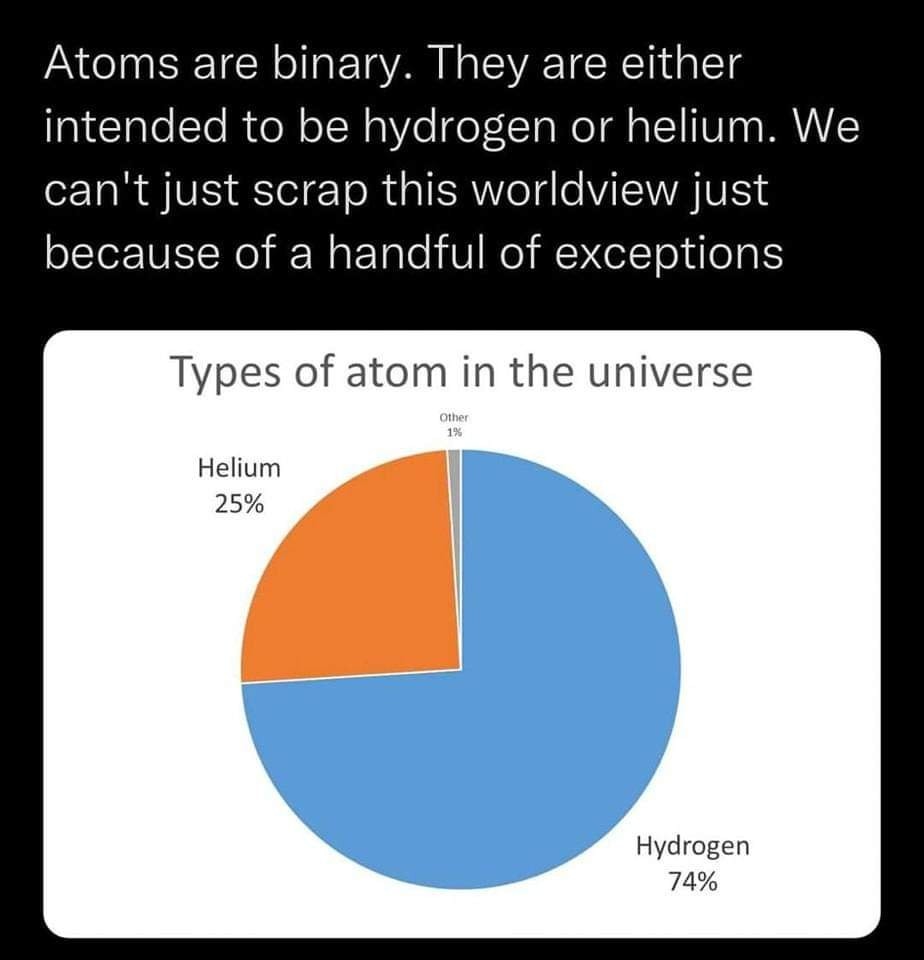
@PugJesus reminds me of the physics proof that all odd numbers are prime
1 is odd and prime
3, ditto
5, ditto
7, ditto
9, experimental error
11, ditto
.
.
.
If you wrote an algorithm that just outputs yes for all youd be 94% correct
AI is about 60-90% correct for comparison
The funniest part about this is 1 isn’t even prime.
That’s always irked me. I get that one is very very special.
It’s probably because I learned that a prime only “has factors of one and itself”… rather than “exactly two unique factors” per se.
It’s more that all the interesting things that come from prime numbers don’t really work if you include 1 as a prime. So every time you talked about primes you would have to say “something something prime number, other than 1, yadda yadda”.
For example: The Fundamental Theorem of Arithmetic states that every natural number can be expressed as a finite product of primes, and that prime factorization is unique.
So
is the only way to express 12 as a product of primes. But if we include 1 as a prime, then
etc. There are infinite prime factorization of every natural number, and the most interesting part of the Fundamental Theorem of Arithmetic no longer holds.
I also always loved Xeno’s paradox … specifically the Dichotomy Paradox (Halving): To travel from point A to point B, you must first reach the halfway point, but before you reach that halfway point, you reach the halfway point of those two points and on and on and on into infinity … which suggests that in order to get from any point A to any point B, you have to cross infinity … but it’s impossible to travel to infinity so the suggestion of the paradox is that you should never be able to reach any point B
I don’t think I get it, the conclusion doesn’t make any sense to me at all
Because yes, there is an infinite amount of infinities when you think of decimals. We have two when it comes to integers - negative infinity and positive infinity, and there is an infinite amount of infinities between any two integers. 0 - 1, but also between decimals 0.1-0.2, etc
That doesn’t mean you can’t add or multiply any two numbers just because there is an infinity inbetween.
We cross infinity all the time. Git gud
… to infinity … and beyond
and you don’t fly there either … you’re just falling with style